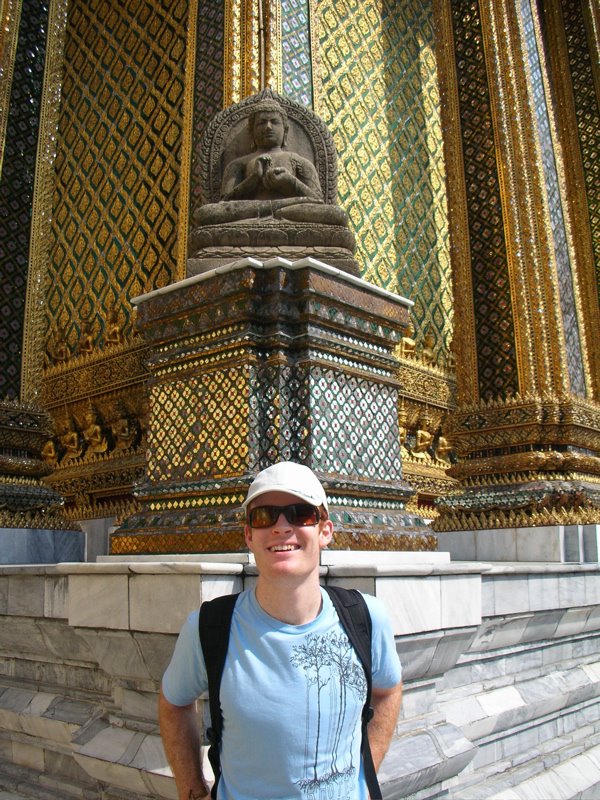
 As an addendum or perhaps apology for a previous post full of white-man guilt, instead I present nice pictures that all can enjoy, with commentary you are free to pass over. Here I am at Wat Phra Kaew, the Temple of the Emerald Buddha. Thai Buddhist architecture really stood out in literally bright contrast to the Japanese temples I am used to seeing. Usually I try to minimize taking pictures of me standing in front of things with a dumb look on my face, so this was taken by Maiko. I much more like to take pictures of her - she, of course, makes a good model - but occasionally she wants ones of me for some reason as well. Anyways, I figure I should have at least one with me in it so it doesn't look like I just pulled these off some Thai tourism website.
  This was the first temple I saw in Thailand, and it blew me away. Cloudy the day before, it cleared up just as we set out that morning, and I honestly had to wear my sunglasses most of the day just to be able to look directly at the buildings. It's difficult to conceive of these being places built by people. Also, I wonder about the religious motive of their construction. Perhaps like European cathedrals they were built to inspire faith by impressing upon citizens the majesty of God, or perhaps not the majesty of the religion but the power of the rulers. Certainly, though amazing, all this ostentation seems rather unbecoming of a Buddhist institution to me.
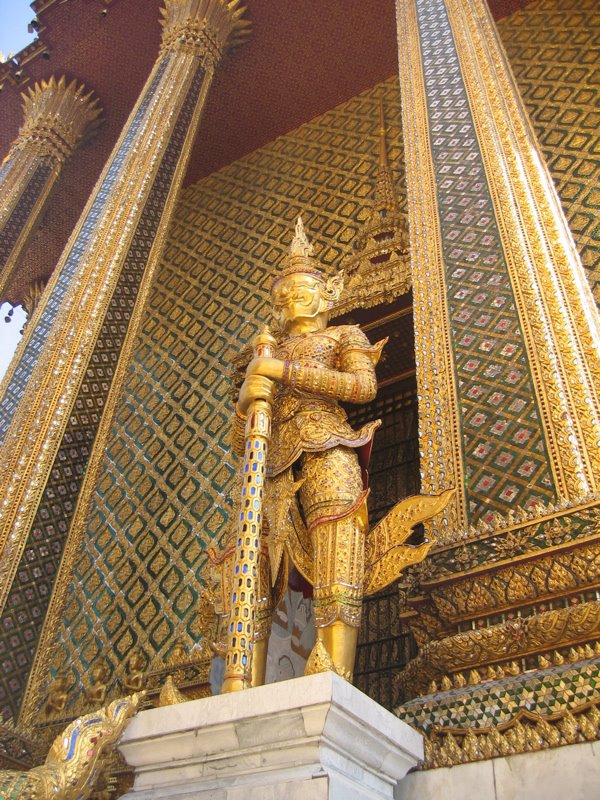 Apparently many people tour the grounds without ever seeing the Emerald Buddha statue itself, which I can understand entirely. After wandering around a while slack-jawed with and gazing up at the sky like some simpleton, I almost forgot myself that the place contains something else worth seeing. The Emerald Buddha however, was rather anticlimatic, being only 66cm tall and placed high above all worshippers in an inner shrine building. I couldn't even take a picture of it, photography being prohibited inside the temple. Actually, photography was prohibited inside most every temple, as these are actually being used by Thais as places of worship. There are swarms of foreign tourists crowding around, oohing and ahhing at the buildings and shuffling into the inner sanctums without properly removing their shoes or hats, yet one still finds Thais lost in reverence or prayer. I suppose they have to practice a great deal of Buddha-proscribed patience just to study the Buddha in the first place.
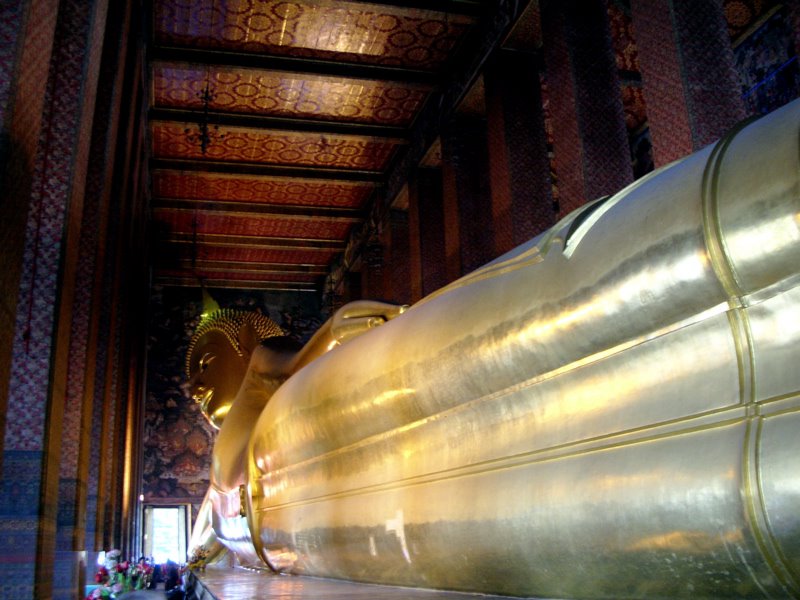 However, this was not a feeling or quality absorbed by much of the other tourists. This was taken at the next temple we visited that day, Wat Pho, the home of the Reclining Buddha. A Buddha in a reclining pose represents him at the very moment of Enlightenment. To take a clear picture of this was quite difficult because of the throng of people that kept knocking into me, walking directly in front of me, or just tapping their feet in exasperation behind me. This reached the apex when I was trying to take a picture of Maiko in front of it and a few fat middle-aged Americans, not content to wait 30 seconds, started clearing their throats really loudly behind my back, wanting their turn. The incongruence and irony of this extreme act of rudeness inside a temple and in front of a GIANT STATUE OF THE BUDDHA, symbol of compassion and contentment, really amused me terribly, but rather than pointing this out to them along with the admonishment that one of the many virtues the Buddha praised was patience, I simply cursed at them in Japanese for a while.
Amusing sidebar to this, I discovered Maiko didn't know what clearing one's throat as a sign of impatience meant, since Japanese people never would do that (A Japanese would simply stand directly behind you very quietly for as long as it takes, and so when you finally turned around to discover they had been inconvenienced you would feel shamed). So she had no problem ignoring them and was just standing their fairly oblivious to what was going on, suspecting they all had sore throats, I guess.
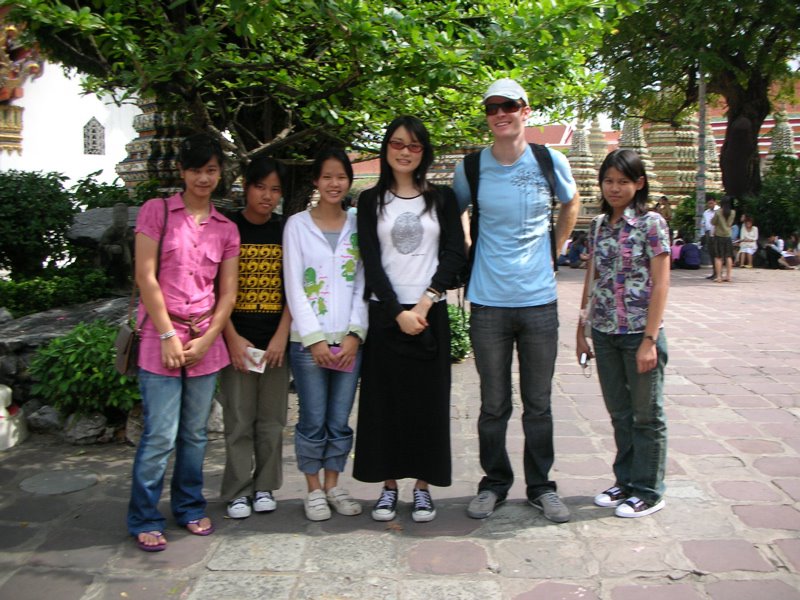 After we viewed the statue, we were walking around the grounds of Wat Pho, thinking about getting a massage at the massage school connected to the temple that had a branch on the grounds. We stroll past a group of four Thai girls, when one of them says something garbled to me in what I take as Thai. I glance back over my shoulder, "Eh?" They get real excited that I responded and rush back to us, and, holding out their cameras, ask in labored English if we would take a picture. I am rather suspicious at this point because earlier some guy outside the temple had tried to tell us it was closed for Christmas and we should go with him to another temple, which I knew was a scam, having read about a similar approach as well as being generally aware that there is no reason a Buddhist temple in a country that doesn't celebrate Christmas would be closed on a Christian holiday. No harm done, except of course to my attitude towards people approaching us. After a string of such experiences, I honestly suspect that perhaps these girls are going to distract us while someone comes up from behind to pick my pocket. So, eyeing them warily, I agree to take their picture.
"No, no!" they say, "Not our picture, a picture with you two!" Then I notice that this is just a group of sweet 12 year old girls, and are all carrying English conversation phrasebooks because they wanted to meet people and practice. I relax and shake my head at my distrust of such sincere kids. They pose, excited but embarassed, next to Maiko and I, and we chat for a while. They are extremely excited when they find out she's Japanese, since they also learned a little of that language. Actually, I talk with them in Japanese as well, since I simply cannot understand Thai pronounciation of English. I think they mistake us for stars or some visiting international luminaries, or maybe they just wanted to take a picture with a beautiful Japanese girl and had to accept me as well. Anyway, though I felt rather awful for ever thinking poorly of them, meeting them does raise my spirits again and my kind of hope in the general goodness of people.
 The next day we went on a tour to the ancient capital of Thailand, Ayuthaya. From 1350 to 1767, when Thailand was still Siam, Ayuthaya served as the royal capital, a cosmopolitan city of more than a million people. It resisted almost four centuries of attempts at colonization by Western powers, only to be conquered and almost entirely razed to the ground instead by the Burmese atop battle-trained elephants(!). A few years later, the Thai regrouped under a new general and eventually moved the capital down river to what would later become Bangkok. The former capital Ayuthaya was left behind, and so remains today largely in ruins.
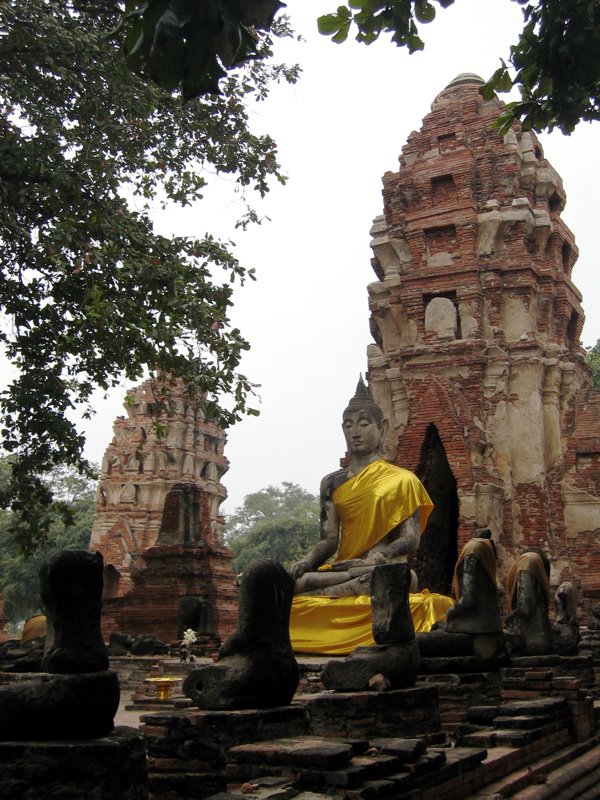 Though the fires of the Burmese conquerors and time itself have clearly left their mark on the buildings in the former capital, the most shocking desecration has to be the deliberate way the heads were lopped off nearly every Buddhist statue. It is rare to find one with the head still intact, since it seems they were just systematically decapitated by the invading forces. At first I assumed it must have been for religious reasons; similar to the Taliban destroying icons in Afganistan or the destruction of Greco-Roman statues of the naked human form. I thought the Burmese must simply be Muslims, since I couldn't imagine Buddhists or Hindus or any other of the religions of the region sanctioning pointless destruction such as this.
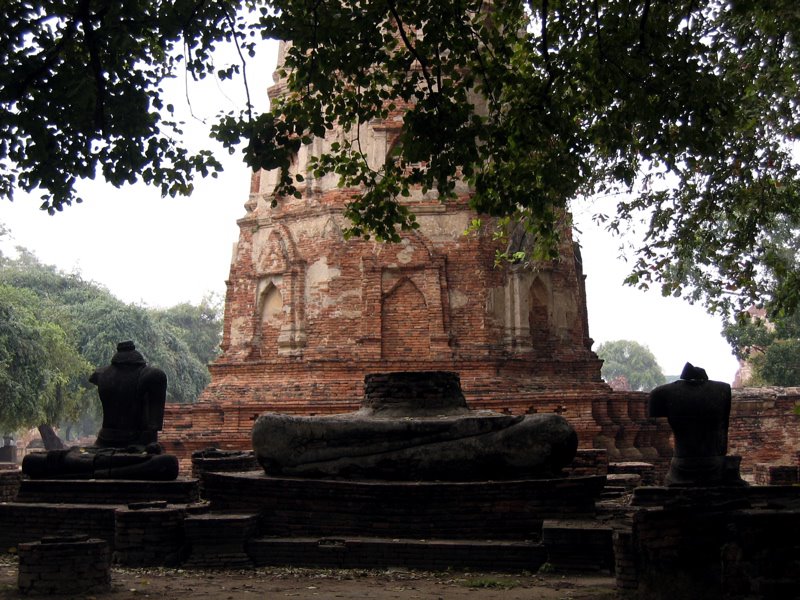 It turns out, however, they were Buddhist just as the Thai, and had cut off the heads as if the heads of their vanquished enemies. The whole scene was just one of ruin and quiet desolation. Not just in the sense of Shelley's Ozymandias, the sort of ruin that awaits all human pride and endeavor, but it seemed to me to be the ruin of humanity itself. Frankly, looking at all these statues made me more sad perhaps than the idea of all the Thai that were no doubt killed at the same time. To just destroy art and culture so wantonly displays not just a disrespect for human life, not just a hatred for another enemy or group, but a disrespect and hatred for humanity itself. To destroy the essence of the people conquered, that which is captured in their art, is to strike at their very humanity, and reveals a lack thereof in the conqueror.
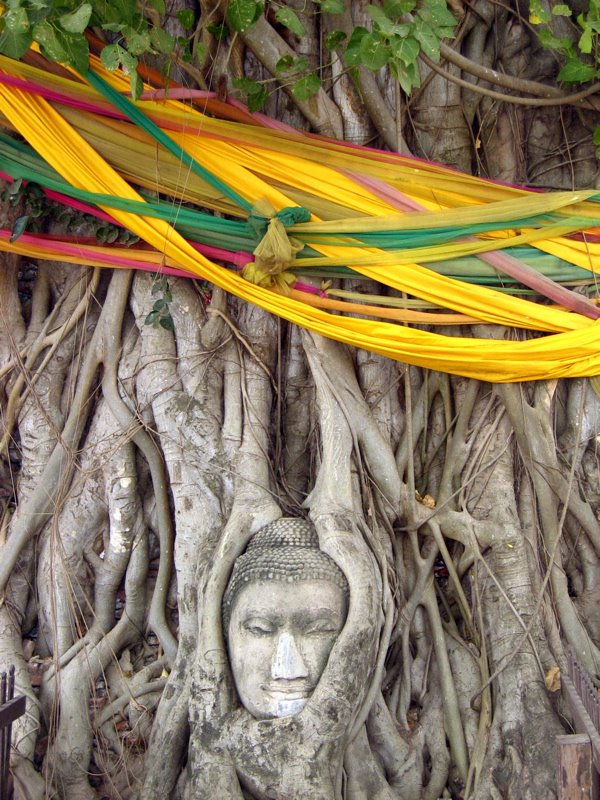 When I told Maiko how sad it seemed she agreed that it was sad in what it showed us of people, but maintained that if the Burmese had wanted to really erase or mock the power of the statues, they had failed. To her, the statues were not sad, because - though they had been defaced, destroyed, humiliated - in reality, nothing could touch them or what they represented, as each statue was of a Buddha that had already reached Englightenment. For her, they were in this sense somewhat inspiring, having already transcended this place to somewhere they could not even be touched. I was rather impressed by her answer but, of course, pride would not allow me to admit this to her fully at the time. This is actually a rather interesting example of that triumph, a famous spot where a tree has enveloped a ruined statue and now cradles a Buddha head in its roots.
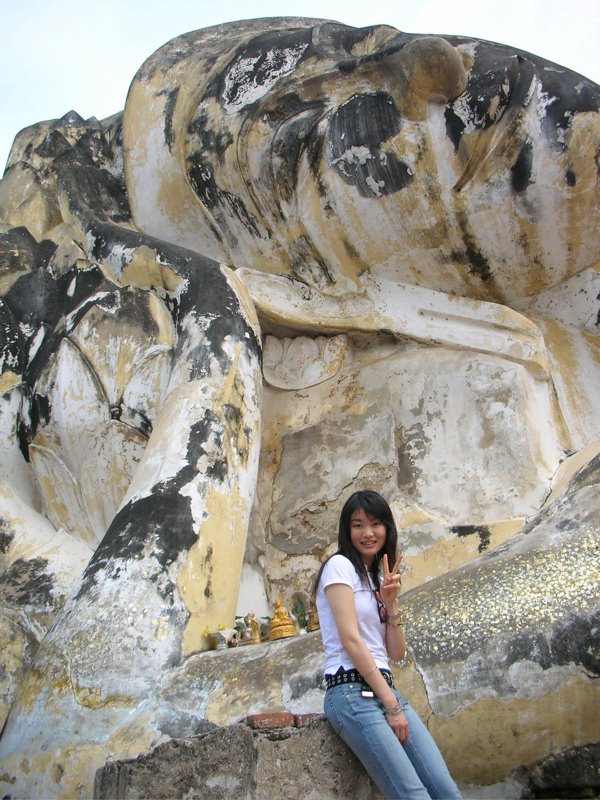 From there we saw the largest statue of the reclining Buddha - larger than the previous one, but at this size, the difference is pretty negligible. I find myself impressed by the size or magnitude or beauty of sculpture such as this, but often lacking any inspiration from faith. It's similar to why I didn't really enjoy the Louvre; I just don't feel anything looking at hundreds of pictures of Jesus and Mary, yeah they have halos behind their heads, they're holy I get it and I don't care. So, it was useful to have Maiko along as somewhat of a spiritual advisor; I can view the art or temples as a believer or, at least, someone more spiritual, through her eyes. She was touched by the happiness and contentment in the expression of the statue. I noticed how big it was. Putting those together, I have decided it was a really big, happy statue.
 The trip back from Ayuthaya was a river cruise all the way to Bangkok. After lunch on board we could simply look out the windows at the passing scenery or go up on deck for a better look. The third option was to stay inside and look at a small tv playing old episodes of America's Funniest Home Videos. What blew me away was how many people took the third option. I wouldn't watch that show if I were sitting at home alone, sick, bored and unable to sleep in the middle of the night, yet people sat in a boat cruising down a river in Thailand on a trip they likely spent large sums of money on more interested in watching the antics of Bob Saget then craning their heads slightly to the right or left to see all the crazy shit passing them by. I spent a disproportionate amount of time complaining to Maiko about these people until she told me to stop wasting time criticizing them then and go up on the deck already.
 The view of the riverside is a sort of fascinating sped-up timeline of Thailand, from the ruins of the old capital down through the countryside, the banks going from deep jungle to shacks and temples poking out from the brush, to the gradual paring away of the wilderness as the buildings get larger and more modern. Going past us on both sides zip men in thin, long and knife-like boats, couples being sheperded around on private cruises, giant barges being towed downstream, and fishing boats pulling long nets that scape the bottom. I spend most of the time trying to get a "Thailand" picture of one of the long boats in front of a temple, a skyscraper, or the shacks built out into the river on stilts. As you can clearly see, I was successful.
Though the trip went on for another day and there is more to tell, much of it was spent in malls and department stores - not the market stalls and back-alleys one associates with Bangkok - and so I'll just leave it with that last picture that satisfies the concept of Thailand I projected onto the country in the first place.