The younger kendo guy's wife is giving her husband and I a ride, along with the English teacher who hates his job and loves to curse. As we pull up to a red light at the intersection of a major highway, the wife points out that in the lane next to us going the other way, a large chunk of heavy plastic - something that might have fallen of a truck - is sitting in the middle of the road. It's not immoveable or particularly dangerous by itself, but certainly enough to cause an accident if jammed in a wheelwell. "Wow, that's really dangerous!" they all agree. As we watch, a car making a turn onto the road nearly runs over it, barely swerving at the last second to avoid it. The three adults in the car are still watching, rapt. That is, just watching. I am sitting on the left side of the car and so (roads being backwards in Japan) on the opposite side from where this is happening. I look over at the the teacher sitting on my right, waiting for him to do something. He in turn looks out the window and exclaims, "Yeah, that is really dangerous, isn't it?" Then he turns his head right back around. Nobody makes a move.
Finally, it is abundantly clear to me that nobody is going to do anything about this, so I check the light, tell them not to drive away, and open my door. I walk around the back of the car, pick up the hunk of whatever the hell it was and chuck it off the road. As I walk back around the car I see the person behind us eyes-wide in a state of shock after witnessing what I just did. Getting back into the car, the three inside start clapping, crying out "Sugoi! Sugoi!" ("Amazing!") I shake my head, because it's nothing I should be applauded for, it's something that a person should do; to me, really something they should be punished for not doing.
This was a particularly glaring example for me of the difference between my Western morality and that of the ordinary Japanese. Our morality is unconditional, a kind of categorical morality. Things are either morally right or they are morally wrong, though we often disagree as to what is which. In the Judeo-Christian ethic, those ideals of right and wrong were traditionally laid down by God, but they could just as easily be understood in a secular, philosophical sense. The point is that widely, our society works on the basis that there are universal things that we take to be right and wrong, and we act accordingly, bound by these rules individually. In this particular case, it would be wrong for me to watch while some innocent person was harmed. We deal in absolutes.
But, the Japanese morality is not absolute, it is situational. Japanese society is based on relationships to others. The very word in Japanese used to mean "human being" in Japanese, 人間 (ningen), is written with two kanji characters that mean "person" and "between" respectively, giving the word the loose meaning of "between people." A person is what lies between others; more directly, a person is defined by their relationships to others. Traditionally, this would be the Confucian relationships between parents and children, adults and rulers etc. Now, it would encompass the family, friends, classmates at school or coworkers. One basically is identified through these groups- but not only passively, actively; students and teachers at school introduce themselves as "Hamamatsu Minami High School's So-and-So," workers at a company might say something that literally translates as "I'm Japan Airlines' Maiko Iba." (ha)
I used to wonder why Japanese schoolchildren wear uniforms; in the US I thought they were either for religious schools or those with disciplinary problems. Neither is really an issue in Japan (well, discipline would be a problem in some schools but certainly not a high level one like where I teach). I could see how they work to crush individuality, but it seemed like they're doing such a great job of that every day in class already that uniforms are quite superfluous in that respect. I was even more confused as to why kids would wear their uniforms even on weekends and vacations when they didn't have class. Understood in the context of the social structure however, it makes perfect sense. Kids wear uniforms to identify themselves as part of a group - students - and, in fact, the uniforms of particular schools are easily distinguishable, making even further stratification possible. Even the suit of the salaryman - or Japanese businessman - can be another group marker. People's lives seem determined by this "inside" and "outside" dynamic.
As belonging to a group is how a person is defined, so their value within that group is defined by their behavior within. Largely, one's life is supposed to revolve around living within these social circles and cultivating relationships, I suppose. People are bound to correct behavior based on their obligations and connections to others. The constant consideration of others that this necessitates accounts for the fabled courtesy and politeness of the Japanese. That's the upside.
The downside, is what happens when another person is not within this inside circle. That is, what happens when you have no connection to another person, and so no real societal obligations to them?
Think of the car itself as a functioning example of this "inside" and "outside" concept. The people inside the car can watch something happening outside with a sort of moral distance because they have no connection or obligation to those not inside the car. They don't know them, they don't work with them, they've never met them. If someone inside their circle were to be in danger, they should act, but outside of that, there is no bond placed upon them in this situation. To me, it doesn't matter that I don't know those who might be affected, the fact is simply that it is wrong to allow others to potentially be hurt due to ones own inaction. That is, my action stems from a morality based on universal imperatives that decide what is right and wrong, while their morality is situational. When taken outside of a situation, it often ceases to operate or decide behavior. This is not to say that some Japanese people wouldn't help, just that no one is expected to help, or would be judged for not helping. The formality that drives the decisions on moral behavior is what makes the fabled politeness of Japanese people to me chilling, as is not really politeness in our sense at all.
There's an expression in Japanese that aptly describes the situation: "The traveler discards all shame." Japanese tourists are regularly much more rude and ill-behaved when traveling in foreign countries than they ever would be in Japan, because leaving the country frees them from their societal obligations towards others. This detachment has been pegged as one characteristic that made some of the Japanese soldiers in WWII so able to committ heinous and dehumanizing acts against the peoples of Korea and China. The Japanese were free from the bounds of their country and its expectations, and the other Asians did not belong to this inner group of Japanese that would accord them fair treatment, but instead basically existed outside in an area in which actions against them were held to no moral standard.
This is not to suggest, of course, that the Japanese are somehow alone in the tendency to marginalize connections to another group in order to easily ignore basic human obligations to one another; this is obviously a constant underlying all aspects of abusive behavior within human civilization, from petty racism to genocide. I am, however, particularly struck by how dangerously open their society leaves them to this sort of moral ambiguity. If they can ignore another Japanese person in such a cavalier way simply because they don't belong to one of the same social circles, imagine the possible attitudes one could have against foreigners, who are basically not even placed in the same circle of humanity as the Japanese themselves.
My three friends in the car are, to me, incredibly kind people. The two teachers work tirelessly to help their students succeed, and if I needed their help, they would no doubt be there. But, it's precisely this fact that makes such an innocuous event so unnerving to me. When these things happen, I feel as though my basic assumptions of human nature have been shattered.
Wednesday, May 10, 2006


Thursday, April 27, 2006
A picture instead of a thousand words
If you look on the right of the page you should now see a link to my Flickr site. I've posted some shots I've taken that I think are worth looking at, and since I've gotten myself a fancy new camera, expect more photos up here soon. At least, photos soon relative to posting on the blog.
Wednesday, April 19, 2006
Back to school...
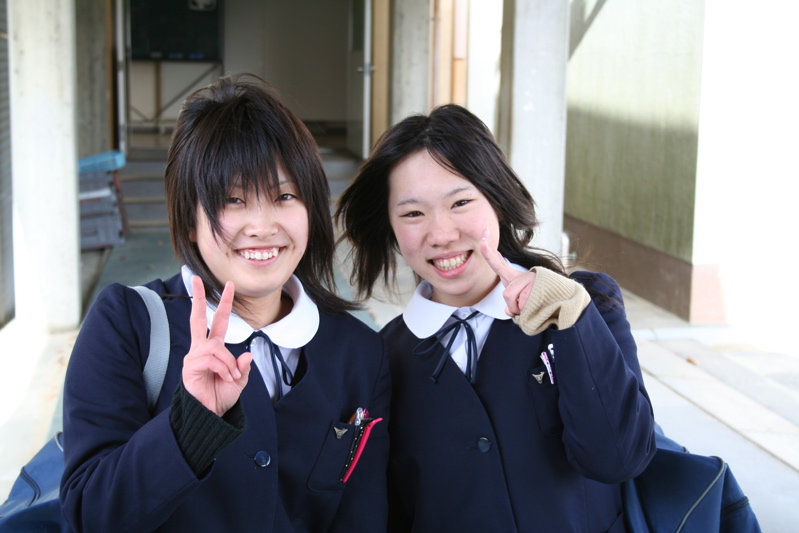 It's the first full week of class now at Hamamatsu Minami, and I'm already exhausted.
 I had finally established a relationship with a lot of students and teachers at the school. Kids knew me and I knew them, and I was settling into a real place at school. But in Japan the school year starts in April, so all the older kids move on and I get to meet a whole new year of incoming students. All the older students had finally gotten used to seeing me to the point where they would no longer cry out when I walked around a corner in front of them, but would actually smile and say hello - or in this case, pose for a picture. Really, most of the kids I taught are unbelievably sweet (like the two in the picture) and I loved my classes with them, so much of this is just missing the old kids. Now I get to go back to square one again with 400 new faces. Faces made up of all gaping eyes and jaws hanging open, slack and dumbstruck. I was beginning to get tired of not being gawked at like some anthropomorphic panda all day, so this comes just in time.
With the new students have come a lot of new teachers as well, since teachers in Japan are rotated from school to school on a fairly regular basis. Although they hide it a bit - only a bit - better than the students, the new teachers are just as bad, really. It's especially annoying as these students and teachers are all new to the school, while I've been working here for more than 8 months. By all rights they should be the ones feeling out of place, not me. Of course, this is an unrealistic expectation, since I'm always going to be an oddity here, but it's still a little trying.
Not that the attention really bothers me; I think it's more that is just kind of bores me now. People here are always trying to talk to me, asking me questions about where I'm from, what I think of Japan, which Japanese food I like the best, etc. And, there was a time when I eagerly responded to these questions and had many of my own because there was a time when I was really interested and excited about meeting anyone I could here. But, one thing I've come to realize is that the time has long past where I was fascinated by the "exotic" Japanese people. No more, "WOW IT'S A REAL LIVE JAPANESE!" They're just people, and just like all other people, there are bad ones, good ones, and a whole hell of a lot of mediocrity in between.
However accustomed I am to them though, they are still interested in me. Interest I understand and appreciate; interest in another person because of their different viewpoints, experiences, or just general good qualities. But most interest in me is not really in me, but in my big, lanky white ass. And this is boring. I'm just not so pumped about talking about how tall I am, how well I use chopsticks, or whether I can eat sushi.
 (Side note, this is really one of the most irritating things Japanese people will ask you regularly. Irritating because they ask, not "Do you like sushi?" which is a fair question, but "Can you eat sushi?" This is different as it seemingly implies that it's only the Japanese that are really capable of eating raw fish. First, I might point out that there are like six sushi restaurants in my home town alone, aside from how many there are in most any other metropolitan city anywhere in the world. But this question gets asked for all kinds of Japanese food, not just sushi. Often, it's regarding some sort of disgusting boiled, cold vegetable dish, because Japanese and vegetables seem to be like American Indians and buffalo; they eat every damn part. Take a look at the picture of a course at a dinner in Kyoto. Beautiful yes, but a beautiful arrangement of things that are mostly not fit for human consumption. This is why whenever I'm cooking with Maiko I always have to keep an eye on her because I'm suspicious she's going to try to slip the onion peel or discarded shavings of carrots into the meal.
When I get one of these weird vegetable parts planted in front of me I will balk, to the endless fascination of the others present. "Can you eat it?" they wonder. So, I usually say, sure, I could eat that thing that looks like lawn clippings that accidentally fell into the pot. But then again, I could eat anything. I could just as easily eat plastic, a piece of cardboard, or some wood chips - and usually that would be more palatable. But I'm not going to, buddy. This isn't Fear Factor, and I only eat things that taste good.)
Perhaps I'm being a snob about this, but I think about it more in terms of just cultural acclimation. I wouldn't expect a Japanese person living in the US to be fascinated by me because I'm so white, nor would I expect anything more than a roll of the eyes from a Chinese person if I asked them, "Can you eat hamburgers!?!?"
So I'm putting you on notice now, Japanese. Sorry, Japanese people, but you're going to have to do something now, because your mere existence is just not cutting it anymore. And get some new talking points, because the ones you have now are weak sauce.
Monday, April 10, 2006
For future feedback
While it's nice to see that all kinds of people like to read the blog - even indignant Islamists intolerant of irony and people who dislike me on general principle - I'd like to keep this blog concerned with what I am actually writing about. So, if you'd like to write comments about something I'm writing on Japan, for example, please do so. If you have anything else to say, feel free to email me at thedukeinjapan@gmail.com, so we can have a dialogue, witty repartee, or exchange of insults in a forum that my grandparents won't have to be privy to.
Sunday, April 09, 2006
More of my writing
An article I translated was published in the Japan Times today. It was a rather large feature in the print edition, and you can also see it online on the front page of the Japan Times website under "Sunday Features":
http://www.japantimes.co.jp/
Or, it is directly linked here:
http://search.japantimes.co.jp/cgi-bin/fl20060409x1.html
It's about a Japanese woman who lived with the Bedouin, a tribe of nomadic Arabs, in Syria. Though I translated most all of it from the Japanese, I'd like to say a few things up front:
1) The article is a translation, not something I wrote, so I had to be faithful to the original, with reservations
2) I did not translate the captions, and they are a little strange
3) Some extra sentences were added in later by the editor not in the original translation, and they do not mesh well with what I wrote
This aside, it was a fun thing to do, it's exciting to have something published I did - even if I'm not given direct credit on the page - and the start of more freelancing work for me.
http://www.japantimes.co.jp/
Or, it is directly linked here:
http://search.japantimes.co.jp/cgi-bin/fl20060409x1.html
It's about a Japanese woman who lived with the Bedouin, a tribe of nomadic Arabs, in Syria. Though I translated most all of it from the Japanese, I'd like to say a few things up front:
1) The article is a translation, not something I wrote, so I had to be faithful to the original, with reservations
2) I did not translate the captions, and they are a little strange
3) Some extra sentences were added in later by the editor not in the original translation, and they do not mesh well with what I wrote
This aside, it was a fun thing to do, it's exciting to have something published I did - even if I'm not given direct credit on the page - and the start of more freelancing work for me.
Subscribe to:
Posts (Atom)