Monday, August 29, 2005

This water not be good to drink


The level of annoying background noise in Japan is somewhat unbelievable, especially for a nation that is known for its politeness and civility. I'll break it down for you by outlining what you might have yelled at you or blared at you in an average day in Tokyo:

You wake up to the sounds of some ridiculously loud traditional song being broadcast over the local loudspeaker for reasons unknown OR to some sort of earthquake / fire siren, which happens so often that people just basically pretend like it's not happening because they know it's just a drill. Walking to the train station, you pass a Pachinko parlor (Pachinko is roughly equivalent to slots, for all intensive purposes in the awful noise, smoke, and generally dehumanizing effect it has on participants), which is not only decorated with outlandishly garish, giant posters and banners of giant-breasted cartoon women and hugely muscular manga action heroes, but emits an wave of cacophonous bells and rattles every time the automatic doors slide open, which - since people are going in and out all day - happens continuously.

Arriving at the train station, you have the general rush of people and the ticket machines, but, knowing that the Japanese passengers on a train are almost invariably totally silent and the train ride itself smooth, one might be tempted to relax a little; it seems you might be safe for a moment. But the noise isn't coming from the passengers, it's from the near-constant announcements over the PA system. Just on the platform, you'll hear the grating, high-pitch, recorded voice of a Japanese woman informing you when the train is arriving, that it will arrive soon, that it is arriving now (at this point you can see the train), that it is right in front of you (so you know that the train you are looking at is, in fact, a train, that you are not in some sort of non-Cartesian world of illusion), that the doors are about to open, that the doors will soon close, that the doors are now closing (oh, and there's a delightful song accompanying the process). And she will remind you to be careful to stand behind the giant yellow lines, because it turns out that you don't want to be over those, because then you'd fall off the platform and be standing on the tracks, which is, seemingly, a bad place to wait for the train.

Once you are in the train with the doors close and you have been told that the doors are closed, the train conductor begins his dialogue with you about every goddamn stop. Which wouldn't be so bad except that he has to add three sentences of meaningless polite gratitude for your gracious choice in honorably riding the train today, which - be assured - he, as well as the train service, Japan as a country and really, all of its people, feel tremendously blessed to receive. Then he'll list the names of all the connecting lines available at the next stop, tell you all about which door will open when you stop (just in case you are unable to figure that out or need a running start to the door) and affix another blessing on you and your child for having continued riding the train since he started speaking a minute earlier. This usually starts about 10 seconds after getting on the train and ends about 10 seconds before you get off, meaning that the message basically extends from each stop, so you hear it as many times as you are passing stations on your ride. (For me last year, think 10 stations a ride, twice a day, for 9 months)

When you get off the train and out of the train station, you might be in the mood for something to eat. You exit the station but trying to cross the street suddenly are forced to literally cover your ears because someone has pulled up in a van and is yelling directly into your face about your desperate need to oppose the crazy militants who would threaten the perfect peaceful society of Japan that is a beacon of hope to all nations by re-militarizing OR to get those pussies out of power that are dishonoring Japan and its rich history by standing in the way of it re-militarizing.

Entering a restaurant, there are several waiters conveniently situated around the place who immediately begin yelling いらっしゃいませ!(irasshaimase! - "welcome!") at you repeatedly from all directions until you are guided to a table, where you can enjoy hearing them yell that at each new patron as well. Finishing your meal, you are rewarded with everyone in the restaurant now yelling "thank you!" at the same time as you scuttle out the door.

If you choose to go shopping, the shop people will first yell "WELCOME!" at you and "PLEASE HONORABLY LOOK AROUND AND TAKE YOUR HONORABLE TIME ABOUT IT!" everytime they see you, and, strangely enough, every time they see each other as well. I suspect that the job training for stores in Japan requires a sort of Pavlovian training in which the employee is trained to respond to any and all stimuli with a knee-jerk "WELCOME!" (ex: New customer? "WELCOME!"; Another employee? "WELCOME!"; Stray dog? "WELCOME!"; Errant bag floating into shop on gust of air? "WELCOME!")

Deciding to just go home (after going through the train ordeal again) you might stop at the local supermarket for something to cook for dinner. Somebody is going to yell "WELCOME!" at you while walking in the door, make no mistake. And somebody is going to yell it at you while you walk the aisles. But the most insiduous thing about Japanese supermarkets (computer stores and electronics chains are the same way) is the store jingle. Some of them are full songs, but the worst are those that are only 5 seconds, as they repeat endlessly and burrow into your mind until you find yourself walking down the street singing "Bi-ku bi-ku bi-ku Bic Camera!" Case in point, I just sang that aloud unintentionally after typing it. I can also still remember the song from my local supermarket chain, Seims, from a year ago ("Everyday~ Seims, for your body and your mind...")

There are two alternatives to this: One, like me, you simply wear your headphones anywhere you go, insulating yourself completely against the outside world. Two, like most Japanese people, you are conditioned by this level of noise to develop the ability to basically block out all of the outside world. The problem seems to be, however, that this only pushes the people involved - whether it be advertisers or people demanding you hear their gratitude for your patronage - to new heights of shrill annoyance to compete for your attention. But, like my supervisor said when we were in the electronics shop for an hour listening to the jingle for the 1000th time, it's not that people aren't bothered by it, it's just that nobody ever complains.

Saturday, August 27, 2005

Kandou shita

A girl took me totally by surprise today and almost broke my heart.

I was sitting at my desk ramping up to go home for the day, it being shortly after 3pm. Which meant I had succesfully passed 6 hours at the office, quite an accomplishment considering I have no work and only three other teachers were in today (Side note: it often seems like all the teachers get some bulletin I miss about when to come to school, so it's like just me and two other people there in the morning and I always imagine they have some sort of early warning system I don't get, like everyone else knows the school is going to be hit by a tsunami that day or something. Side note to that note: If the Tokai earthquake hits, the school will be hit by 10 meter tall tsunami waves). So I just had to kill time for another half hour or so, then I could start slow preparations to leave. Then I could brace myself for immediate exit at 4 pm sharp, muscles tense for another 5 minutes, watching the slow revolutions of the clock.

BUT, instead I was interrupted from my vigil by an English teacher, who presented to me one female student who was apparently working on a speech for the English speech contest to be held next month, and instructed to correct it for her. Interestingly enough, though it came right before the end of my day and would make me stay late, I was somehow so touched by the idea of having actual work to do that I took it and started through it.

The girl had just returned back from a summer studying abroad in Australia, and her speech began with a conversation between her and her host father, who asked, "Don't you feel homesick for Japan?" At first, the story seemed clear, it's going to be all about her experience in Australia; she found out we're all just people, the same though appearing different, she ate vegimite and saw koalas, blah blah blah Australia. I just start correcting the grammar and explaining the problems to her.

Then I get to the end of the paragraph about her host father. Suddenly the speech shifts from "my host father was a really great guy because even though he worked hard he also did chores and talked to me" to "when I came home and compared him to my father I realized that we don't really have any sort of relationship." It was clear this was a very different kind of speech.

At this point I skip ahead and quickly read the rest of the speech, which is a single, handwritten page on notepaper. This girl explains that her father, who works for Honda, was sent abroad to Ohio when she was only 9 years old. She quickly became used to not having a father around, and didn't really feel any connection to him any more. Even when he returned, they rarely spoke, and though her mother would tell her how her father worried about her, "they had no relationship."

Upon talking to her mom about this recently, her mom remembered a letter the father had written home to the girl and her sister 9 years ago while in Ohio. In the letter, he explained that he was working hard to set up a new factory, and though he was tired, he knew he would become more successful through this work. When the girl read this letter from her father, she felt that he was "maybe a good person, perhaps the word that describes what [she] felt was 'respect.'" She respected her father for working hard to improve himself, and recognized her own work to go to Australia or to study as similar in intention as a form of self-improvement.

The end was what killed me though. Even though she felt more gratitude towards her father for allowing her to go to study abroad, she has never been able to tell him. She confessed she doesn't know what would happen with their relationship in the future. She only hoped that someday she could too become a person worthy of her father's respect, and they could sit across from each other and talk as adults. She had never been able to talk to her father about how she felt. But she invited him to the speech contest, and is hoping that by giving this speech she might somehow break through to him.

She told me this, and I was in kind of in shock. I tried to get back to correcting her paper for her. I walked her through each sentence, but the whole time I was basically trying not to get too emotional, even not to cry. We finally made it to the end of the speech. She asked me what I thought of it, and I told her, 感動した。(I was deeply moved)

She says she just wants them to respect each other, but I thought, why should that be all she can have? Is that really the most she should be able to expect from her relationship with her father, the admiration existing among peers?

I'm not trying to say this is a problem solely of Japan - clearly it is a problem that occurs in every culture and every time - but it is something reinforced or exacerbated here by murderous work hours that make it nearly impossible for even the most devoted father to spend enough time with his children and a culture that discourages any sort of open communication of emotion by men to others. It's a harrowing situation to live in, and likely part of the reason Japan has as many suicides as the entire United States despite having less than half the population; the suicide rate is more than double that of the US or most EU countries.

The point is that this lack of paternal involvement is something I have read about, even told people who asked me about the work environment in Japan. I even speculated about the effect it would have on the lives of my host family; the two young kids were only 4 and 8 but still didn't seem to see enough of their father. But hearing a 17 year old basically confess to me that everything I had heard was true...to personalize this loneliness for me and stand in front of me at once both meekly and bravely...it was hard to be so glib about the topic. To speak summarily on a topic or treat it academically always involves a sense of distance, but there was no distance from this girl. She was there, and she was so goddamn honest and open about how she felt that I had no way of not dealing with it.

I told her that this is common in the US as well, that it happens everywhere. She was not the only one who felt distance from her parents. Hers was not the only parent who could not tell their child how they felt. That I too once felt distance from my father, but we found a way to communicate with each other and now can actually tell each other how we feel. That there could be something better for her, that it doesn't have to just be too successful workers sitting across a coffee table from each other. That he's not your colleague, he's your father, and I'm sure he wants you to be his daughter as well, not his peer.

I was there until nearly 6, and today I felt like I actually might have earned my money for once.

Tuesday, August 23, 2005

Politics at the bus stop


When placed in a foreign land, at first the cultural and political landscape appears rather impermeable. One must follow the mindset of the people to understand their chosen avenue of expression, but this can be daunting without a guide. Navigating the world of Japanese society is a path fraught with difficulties, so I will explicate this particular instance of protest speech for the uninitiated.

This young man makes a rather cogent argument in t-shirt form, suggesting that it is the "public" that hates minorities, for "human" are relieved to "exist in majority." It is this characteristic of humanity writ large that makes them "such weak life." The sheer size of "PUBLIC" serves as a cry out against the immolating forces of conformity, and the desperation expressed in the final statement, "human is such weak life", should be viewed as embodied in the bold type itself. Taken as a whole, the shirt serves to both shock and inform, and performs admirably in both respects.

One only wonders, however, if this young man has anything to offer to this discussion besides criticism, and whether his cynicism might actually alienate others and contribute to the problem rather than allieviate it.

Monday, August 22, 2005

I made $150 today

Today began late, with me arriving at school at around 9:30.

9:30-10:30
The teacher who invited me over to his house for dinner comes over to thank me for the two Beach Boys cds I burned for him, Pet Sounds and Smile. We have an hour-long conversation about our favorite Beach Boys songs (he loves "Sloop John B" and I love "God Only Knows") and discuss the possible causes for Brian Wilson`s breakdown (I explain the rivalry between Brian Wilson and the Beatles and he expounds upon his theory of the "tangled" quality of the Smile songs hinting at the confused nature of Brian Wilson`s mind).

10:30-12:00
The young female PE teacher who sits next to me notices me listening to music on my laptop and comes to look at my music. She gets really excited suddenly and runs out to her car to get two cds she has recently bought, returning with the new Gwen Stefani cd and the new Babyface album. She then plays me her favorite Babyface song and I dutifully transcribe and attempt to translate the lyrics for her on her request. This takes an hour, Babyface lyrics proving more obtuse than you would expect when you have to explain expressions like "the grass is always greener" or "sometimes you don't know what you have until it is gone". The cliches and awful wordplay seem to attain a certain profundity in translation.

12:00-13:00
Lunch. I walk to the 7-11 near the school to buy a drink and eat some spaghetti a teacher cooked for me the other day. I watch an episode of Late Night with Conan O`Brien on my laptop. Laughing aloud, I am prompted by the teacher across from me to repeat this funny joke: "A recent survey conducted in Mexico found that 40% of adults in Mexicans would move to the US, given the opportunity. Researchers explained that the numbers would have been higher, but the other 60% is already living here." Said teacher likewise found our immigration problem most amusing.

13:00-14:00
A Chemistry professor approaches me tentatively and introduces himself in better English than any of the English teachers. Apparently he has listened to English broadcasts on the radio for nigh on 10 years and is entirely self-taught. He shows me a book of English sonnets he is reading and we talk about our favorite British Romantic poets (He likes Browning and I like Shelley). I show him one of my favorite poems, "To My Coy Mistress" by Marvell.

14:00-14:30
I wander the halls for a while listening to music on my ipod, stopping some students dead in their tracks who apparently have not heard about the existence of a new ALT. Dropping by the library to check out a book of Japanese poetry, I am suddenly accosted by three first year boys. Blocking my exit, they interrogate me in Japanese about the finer points of American culture, like whether people really have parties at their house like in "American Pie" (and to a lesser extent, "American Pie 2"). I assure them that not only do people have these parties, but it is so common as to be rather passe. They are suitably impressed.

14:30-16:00
I come back to the teacher`s room to use the internet and write my blog.

I will be paid $150 for today.

Thursday, August 18, 2005

Then she gets chikan-ed...


On Tuesday and Wednesday of this week I was "invited" to a 2-day English Seminar for a local high school, Konan (湖南=lake-west, not Conan the Barbarian / Destroyer / Governor, or of Late Night with _), invited being in quotations since this is what my supervisor said. Really, it is part of my contract, so this was one of those Japanese mandatory "invitations"; delivering an order but couching it in polite language.

The seminar was held at a hotel in the city and consisted of two days of English conversation classes, workshops and activities, the slogan of the camp being "Japanese is not allowed!" 10 ALTs and 40 something first year high school students - mainly girls, since they dominate the English department - from the Konan English program attended the voluntary seminar. I taught 10 50 minute classes with 5 students to a class, and then spent a few additional classes working with one group to develop a skit for the competition held at the end.

At first, adhering to the "no Japanese" policy, I spoke only English to all of the students. They, in return, rewarded me with blank stares and monosyllabic replies. The awkwardness of the situation was enhanced by the fact that each class was held in a large meeting room at this business hotel with a small table placed exactly at the center that served to make us feel more isolated from each other and the silences that much more devastating. I felt like my life was bleeding out of me right there in front of them, their silence swamping my enthusiasm and energy.

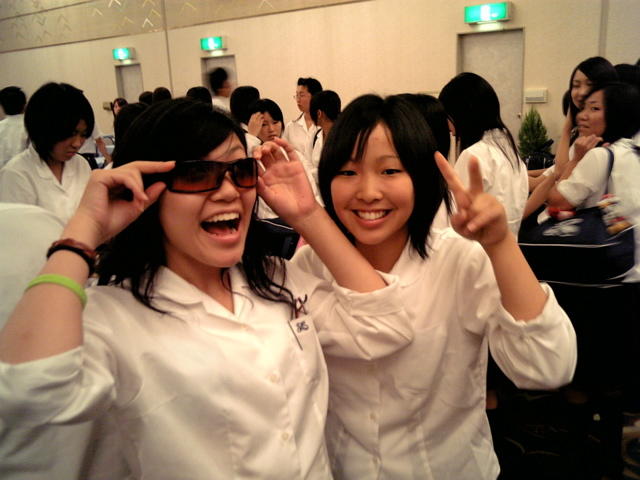
So afterwards, I decided to start speaking a little Japanese with the kids, and that made all the difference. Once they knew I could speak, they would come up to me outside of class to chat or ask me to explain certain words to them, rather then spending the class leafing through a dictionary. Kids also probably became more comfortable speaking to me in their poor English once they heard my own bastardized version of their language. Really, they started talking to me a little too much, especially after I had lunch with the students and happened to find myself sitting next to the popular clique with the two loudest, most outgoing girls. Afterwards, they followed me around for most of the seminar, giggling and taking pictures of me with their cell phones.

The best part of the seminar though, was writing the skit. My group was assigned the scenario: "Someone is being annoying on the train. Tell them to stop" So we brainstormed what would happen like that on a train, and for the students, the obvious response was chikan, or the perverts that grope women on trains. This is a bit of an epidemic in Japan, with trains being so crowded that men at night sometimes take advantage of the cramped trains to try to grope women. (http://abcnews.go.com/GMA/International/story?id=803965&CMP=OTC-RSSFeeds0312) It's amusing that the girls were making a skit about grabbing each other on a train, but it is doubly amusing to me that it is so commonplace in the culture and basically taken as a matter of course that it is something that can be joked about.

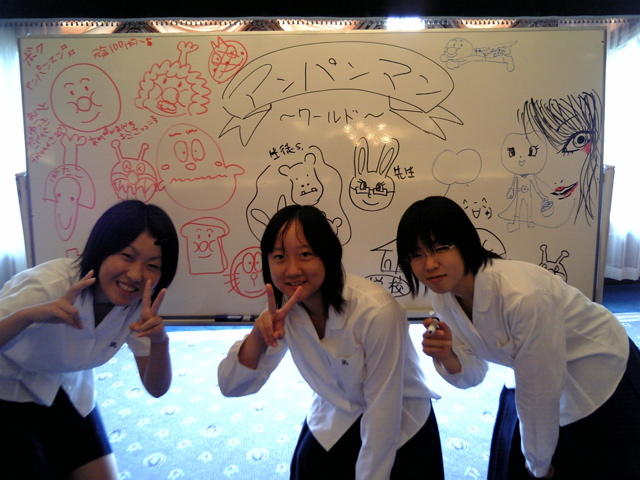
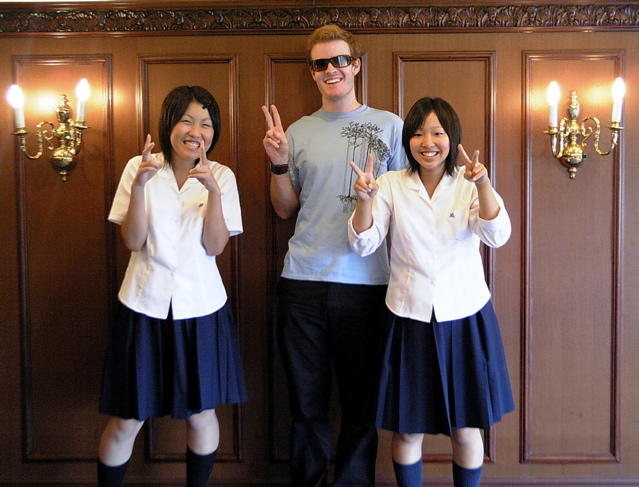
My group was four girls, Yurie, Yumi, Kumiko, and Kyoko, and a boy, Yuuki. Yurie (left) was an extremely shy girl, rather tall, who barely spoke at all, and never in English, and spent most of the time in class covering her face with her handkerchief. Yumi (right) was this tiny little nerdy girl with glasses and hair that came down over her face. Kumiko (middle) had lived abroad, was a bit more confident speaking than the others and the only one who could really speak English. Kyoko was one of the previously mentioned chatty popular girls (the one not wearing my sunglasses), really loud and hilarious, very cute. Yuuki was really a shy little boy basically, but tried to hide it by acting cool and nonchalant about everything. Like most Japanese boys, he bored the hell out of me with his lack of personality.

Try to keep a picture of these kids in mind when reading this, and keep in mind they are all wearing their school uniforms too, which makes this even more amusing. So the skit that they eventually produced ran as follows:

Yurie - Chikan victim
Yumi -Chikan #1
Kyoko - Chikan #2
Kumiko - Chikan #3

[Yurie walks into the train car and grabs the overhead handle]

Yurie: I am so glad I caught the last train

[Yumi is a few yards to the side of Yurie in the train and eyes her]

Yumi: Oooo! That girl is so pretty, and alone!

[Yumi shuffles to the side to get a little closer. Yurie notices and moves away. Yumi scuttles closer; Yurie inches away again.
They chase each other around the train until Yurie, trying to escape Yumi, unwittingly backs right into the waiting Kyoko, who then grabs her ass instead]

Kyoko: Ohhh yeah! And nobody is going to stop me!

[Kumiko walks on the train and arms raised, yells]

Kumiko: I will stop you! Me and my two guns here (poses, flexing biceps and then kisses each fist alternately) are going to take care of some business.

Kyoko: Bring it on then, punk!

[They circle each other, Kyoko looks ready to hit her but instead suddenly whips around and runs off]

Kumiko: I saved you. [Puts her arm around Yurie (who is actually maybe 5 inches taller than her, which is hilarious)] How about a drink?

Yurie: As IF! I didn't need your help anyway, you pervert!

[She walks off the train and Kumiko chases after her]

[Yumi is still standing in the train the whole time and after a few seconds sighs]

Yumi: ...I am so alone.

End scene.

The skits were all supposed to have a moral or message at the end. I guess our's was "Everyone on the train is probably a pervert"? But God, I laughed so hard and was so proud of these kids for their guts. I couldn't believe that Kumiko actually stood in front of all her classmates and flexed and kissed her fists, and Yumi's downtrodden look and slumped shoulders when she delivered her final line just killed me.

Unfortunately, though our skit was by far the most amusing, we were having such a good time thinking of lines for the skit that we didn't finish writing it until 5 minutes before we had to perform, and so nobody had their lines properly memorized. So we didn't win this contest based on delivery and grammar, but we made everyone else competing look boring and lame, which in the end, is all that really matters.